
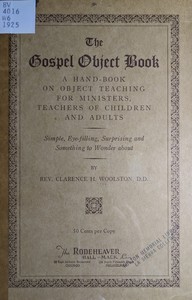
The gospel object book : A hand-book on object teaching for ministers,…
Okay, let's clear this up first: this isn't a novel. There's no plot twist or villain to defeat. 'The Gospel Object Book' is a manual, but it's one of the most fascinating and practical ones I've ever come across. Published in the early 1900s, it was written for ministers and Sunday school teachers who wanted to make their lessons unforgettable.
The Story
The 'story' is the author's mission. Clarence Woolston believed people learn best through their senses. So, he wrote a guide filled with over 300 specific object lessons. Each entry takes a common item—a nail, a mirror, a coin, a lamp—and lays out a clear, step-by-step way to use it as a teaching tool. For example, he explains how a simple broken clock can illustrate a life out of sync with purpose, or how a sealed letter can represent a heart closed off to new ideas. The book is structured by topic (like 'Lessons on Salvation' or 'Lessons for Children's Days') so you can find the perfect visual aid for whatever you're trying to communicate.
Why You Should Read It
Here's the thing that surprised me: this book is incredibly creative. Woolston had a knack for finding profound meaning in the ordinary. Reading it sparks your own imagination. You start looking at a loaf of bread or a door key and thinking, 'Huh, what story could this tell?' It's a masterclass in making abstract concepts concrete. While it's written from a Christian perspective, the core technique—using objects as metaphors—is universal. Any teacher, speaker, writer, or parent can steal these methods. It reminds us that the most powerful communication often doesn't need fancy words; it needs a connection to something we already understand with our hands and eyes.
Final Verdict
This is a niche gem, but a brilliant one. It's perfect for history lovers curious about early 20th-century teaching methods, creative types looking for a spark, or anyone who communicates for a living—pastors, teachers, coaches, you name it. The language is old-fashioned, so it's not a breezy beach read, but the ideas inside are timeless. If you're tired of dry explanations and want to learn how to make your messages stick, this century-old playbook might be exactly what you need.
No rights are reserved for this publication. Enjoy reading and sharing without restrictions.
Donald Hill
1 year agoI came across this while browsing and the character development leaves a lasting impact. Exceeded all my expectations.
Michael Garcia
1 year agoAfter finishing this book, the arguments are well-supported by credible references. Truly inspiring.
Jennifer Ramirez
1 year agoSimply put, the plot twists are genuinely surprising. Worth every second.





Charles Nguyen
9 months agoText is crisp, making it easy to focus.