
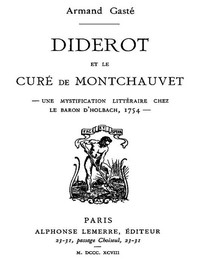
Diderot et le Curé de Montchauvet by Armand Gasté
So, here's the scene: It's 1773. Denis Diderot, one of the brightest minds of the French Enlightenment, is on the road. His carriage gives out near a nowhere village called Montchauvet. With no other options, he seeks shelter at the local presbytery with the parish priest, Father Mignot. For three days, these two men—symbols of utterly different worldviews—eat, drink, and talk under one roof.
The Story
Armand Gasté's book works like a detective story for history lovers. There's no single diary from those three days. Instead, Gasté gathers the clues: a handful of letters Diderot wrote afterward mentioning the visit, what we know about the priest, and the social context of the time. He tries to build the most likely picture of what happened. Did they debate the existence of God? The role of the Church? The rights of man? The book suggests they talked about everything from farming and village life to big philosophy, likely finding both friction and surprising moments of agreement. The real tension isn't in dramatic shouting matches, but in the quiet, awkward, and possibly respectful space between two intelligent people who see the universe in fundamentally different ways.
Why You Should Read It
I loved this because it makes big historical ideas feel human. Diderot isn't just a statue or a name in a textbook; he's a traveler with a broken carriage, probably bored and curious. The priest isn't just a symbol of the old regime; he's a man doing his job in a small parish, showing hospitality to a stranger. Their encounter is a tiny, perfect drama of the Enlightenment era. It asks questions that are still relevant: How do we talk to people we disagree with? Can we find shared humanity when our core beliefs clash? The book doesn't give easy answers, but watching Gasté piece the moment together is its own reward.
Final Verdict
This is a perfect pick for anyone who enjoys micro-history—those books that zoom in on one small event to tell a bigger story. It's great for readers curious about the Enlightenment but who want to avoid dense, academic tones. If you liked books like The Professor and the Madman or enjoy narratives built from fragments of the past, you'll get a kick out of this. It's a short, thoughtful, and oddly charming look at a forgotten long weekend that speaks volumes about its time.
Legal analysis indicates this work is in the public domain. Access is open to everyone around the world.
Michael Martin
3 months agoI stumbled upon this title and the arguments are well-supported by credible references. I couldn't put it down.
Joshua Taylor
1 year agoBased on the summary, I decided to read it and the clarity of the writing makes this accessible. Thanks for sharing this review.
Thomas Moore
6 months agoHonestly, it challenges the reader's perspective in an intellectual way. Exactly what I needed.

Emma Flores
1 year agoVery helpful, thanks.