
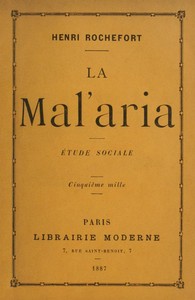
La Mal'aria: Etude Sociale by Henri Rochefort
Henri Rochefort was a firebrand. In 19th-century France, his newspaper articles were like grenades thrown at the government. La Mal'aria: Etude Sociale is that same explosive energy channeled into fiction. It’s less a traditional story and more a passionate case against the society he lived in.
The Story
The plot follows a young, educated man trying to make his way in the world. He starts with hope and principles, believing in hard work and honesty. But he quickly runs into a wall. The world doesn't reward merit; it rewards connections, money, and a willingness to play dirty. We watch as he's cheated by businessmen, looked down on by the aristocracy, and worn down by a system designed to keep people like him in their place. His spirit sickens—not from a physical fever, but from the 'bad air' of a corrupt environment. The story shows his struggle, his moments of compromise, and the high cost of trying to stay clean in a muddy world.
Why You Should Read It
You don't read this for a light escape. You read it for the raw, unfiltered anger. Rochefort isn't subtle. His characters are often vehicles for his ideas, but that's the point. The power comes from the sheer conviction behind the words. It’s a window into the frustrations of an era—the same frustrations that would soon boil over into major political upheaval. What grabbed me was how familiar the complaints feel. Swap out the carriages for cars, and his attacks on a rigged system, unfair wealth, and public hypocrisy could be written today. It’s a historical novel that doesn’t feel stuck in the past.
Final Verdict
This book is perfect for history buffs who want to feel the pulse of 19th-century social criticism, not just read about it. It’s also great for readers who enjoy politically charged fiction, like a darker, less romantic cousin to some of Dickens' social commentaries. If you prefer straightforward plots with clear heroes and villains, this might feel a bit heavy. But if you're in the mood for a provocative, idea-driven story from a man who was genuinely furious at the world, La Mal'aria is a compelling and bracing experience. Just don't expect a happy ending.
No rights are reserved for this publication. It serves as a testament to our shared literary heritage.
Andrew Davis
5 months agoI didn't expect much, but the clarity of the writing makes this accessible. I would gladly recommend this title.
Kimberly Jackson
1 year agoNot bad at all.
James Torres
1 year agoClear and concise.
Liam King
8 months agoThis book was worth my time since the arguments are well-supported by credible references. Highly recommended.






Barbara Robinson
5 months agoNot bad at all.