
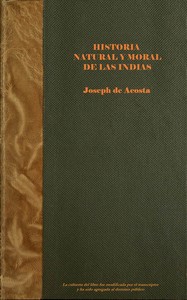
Historia natural y moral de las Indias (vol. 1 of 2) by José de Acosta
Published in 1590, this isn't a novel with a plot in the usual sense. Think of it as a guided tour of the Americas through the eyes of a deeply curious, and sometimes conflicted, 16th-century Jesuit. Acosta spent nearly two decades in Peru and Mexico. In Volume 1, he sets out to describe everything. He starts with the physical world: the baffling new animals like the llama, the strange plants like maize, and the terrifying geography of the Andes. He then moves to the 'moral' history—the cultures, religions, and governments of the Inca and Aztec empires.
The Story
The 'story' is Acosta's intellectual journey. He systematically observes, questions, and tries to explain. How did people and animals get to the Americas? (He guesses land bridges, which was radical for his time.) Why do the stars look different in the Southern Hemisphere? He details Inca roads and Aztec markets with genuine admiration, but then struggles to square their complex societies with his belief that they were living in spiritual darkness. The central thread is his attempt to build a bridge between the world he knew and the one he was discovering, using both reason and faith as his tools.
Why You Should Read It
What grabbed me was Acosta's voice. He’s not a distant historian; he’s a man in the middle of it, amazed and puzzled. You feel his wonder at seeing a volcano for the first time, and his frustration when classical European knowledge fails to explain it. The book is a snapshot of a worldview stretching to its limits. It’s also surprisingly humble at times. While he firmly believes in converting the indigenous peoples, he argues against the idea that they are naturally inferior, which was a big deal back then. Reading it, you witness the very birth of anthropology and natural science in the Americas, complete with all its growing pains.
Final Verdict
Perfect for history buffs who want to go beyond dates and battles, or for anyone interested in the history of science and cross-cultural encounters. It’s not a light read—the language is old and the concepts are dense—but it’s incredibly rewarding. You’re getting a front-row seat to a massive shift in human understanding. If you enjoyed books like Guns, Germs, and Steel for their big-picture thinking, you’ll appreciate seeing those questions asked for the very first time, by a man who had dirt from the Andes on his boots.
Legal analysis indicates this work is in the public domain. You are welcome to share this with anyone.
Linda Davis
5 days agoHaving read this twice, the plot twists are genuinely surprising. Truly inspiring.
William Garcia
4 months agoHaving read this twice, the pacing is just right, keeping you engaged. I will read more from this author.
Patricia Smith
7 months agoWithout a doubt, the storytelling feels authentic and emotionally grounded. Exactly what I needed.
Joshua Martinez
1 year agoThanks for the recommendation.








Donald Lee
1 year agoVery interesting perspective.