
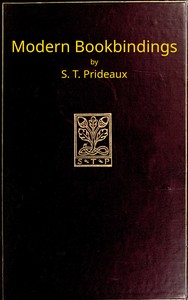
Modern bookbindings: Their design and decoration by S. T. Prideaux
Forget everything you think you know about dusty old books. Sarah Treverbian Prideaux's Modern Bookbindings: Their Design and Decoration is not a dry manual. It's a guided tour through a golden age of craftsmanship, written by someone who was right there in the thick of it. Published in 1906, this book captures a moment when bookbinding stopped being just a practical trade and became a full-blown art form.
The Story
Prideaux doesn't give us a fictional plot. Instead, she maps out the real-life revolution happening on bookshelves. She walks us through the major British and French binders of her day, people like Cobden-Sanderson and the Guild of Women Binders. She shows us their tools, their techniques (like 'inlay' and 'pointillé'), and most importantly, their creative philosophies. The 'story' is the shift from mass-produced, identical covers to unique, hand-tooled masterpieces that reflected the book's content and the binder's own artistic voice. She explains how a cover's design—the choice of leather, the pattern of gold tooling, the use of color—was a conscious artistic statement.
Why You Should Read It
You should read this because it gives you superpowers. Seriously. After reading Prideaux's clear explanations and seeing the detailed plates (which are fantastic), you'll never glance at an old book's spine the same way again. You'll start to recognize styles and eras. You'll understand why a simple geometric pattern can be more radical than a lavish floral one. Prideaux's passion is contagious. She writes not as a distant historian, but as an advocate and expert who wants you to appreciate this art. She makes you see the book as a complete object, where the cover and the text inside are in conversation.
Final Verdict
This book is a perfect match for curious minds who love art, history, or books themselves. It's ideal for the reader who enjoys 'behind-the-scenes' looks at how beautiful things are made. If you're a fan of the Arts and Crafts movement, this is an essential primary source. While it's over a century old, its insights are timeless. It's a love letter to craftsmanship that reminds us to slow down and appreciate the artistry in everyday objects. Just be prepared—you might find yourself gently stroking the covers of old books in secondhand shops, seeing them in a whole new light.
There are no legal restrictions on this material. Feel free to use it for personal or commercial purposes.
Barbara Young
1 year agoRead this on my tablet, looks great.
Jessica Johnson
1 year agoLoved it.






Margaret Lee
10 months agoThis book was worth my time since the pacing is just right, keeping you engaged. Highly recommended.