
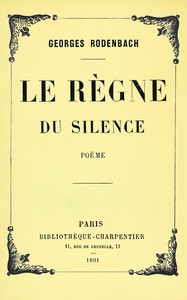
Le règne du silence : poème by Georges Rodenbach
Originally published in 1892, Georges Rodenbach's Le règne du silence is less a traditional story and more of a mood piece, a prose poem that wraps you in the fog of a Belgian canal town. It's famous for making the city of Bruges a symbol of melancholy and memory.
The Story
We follow Hugues Viane, a wealthy and deeply sad man who has lost his beloved wife. Instead of trying to move on, he embraces his sorrow. He moves to Bruges, a city he sees as the perfect reflection of his inner state—quiet, still, and haunted by the past. Hugues doesn't just live in Bruges; he merges with it. He wanders its misty canals, its silent squares, and its empty churches. He becomes obsessed with preserving everything exactly as it was, from his wife's untouched room to the very atmosphere of the city, which he fears will be ruined by modern life and noise. His life becomes a ritual of remembrance, and the line between loving a memory and being a prisoner of it gets very, very thin.
Why You Should Read It
Don't come to this book for a fast plot. Come for the atmosphere. Rodenbach paints with words. You can feel the damp air, see the gray light on the water, and hear the profound quiet. It's incredibly immersive. The real magic is how he turns a city into a character. Bruges isn't just a setting; it's a state of mind. Hugues's struggle is something I think we can all understand on some level: the desire to freeze a perfect moment in time, to live in a beautiful, sad memory because the present feels too loud or too painful. It's a book about the danger and the seduction of nostalgia.
Final Verdict
This is a book for a specific mood. It's perfect for a quiet, introspective evening, preferably with a window looking out at rain. Ideal for lovers of Gothic atmosphere, poetic language, and psychological depth over action. If you enjoyed the haunting vibe of Edgar Allan Poe or the slow, descriptive beauty of novels like The Shadow of the Wind, you'll find a kindred spirit in Rodenbach. It's a short, haunting read that stays with you, like the echo of bells over still water.
You are viewing a work that belongs to the global public domain. You are welcome to share this with anyone.
Kenneth Smith
1 year agoVery interesting perspective.




Richard Harris
1 year agoVery interesting perspective.