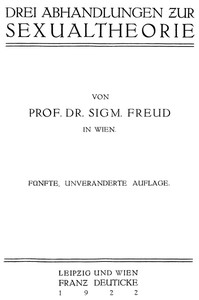
Drei Abhandlungen zur Sexualtheorie by Sigmund Freud
Let's be clear from the start: this isn't a novel. There's no plot in the traditional sense. Instead, think of it as a groundbreaking—and deeply argumentative—instruction manual for the human sexual drive, written at a time when most people wouldn't even talk about it.
The Story
Freud breaks his theory into three parts. First, he tackles 'sexual aberrations,' looking at what society called perversions. He makes the radical argument that these aren't alien to 'normal' sexuality but are part of the same spectrum. The second essay is the real bombshell: 'Infantile Sexuality.' Here, Freud insists that kids are not innocent, asexual beings. He describes stages of development (oral, anal, phallic) where pleasure comes from feeding, eliminating, and exploring the body. This, he says, is the foundation of everything that comes later. The final essay examines the messy transition of all that childhood energy into the focused sexual aim of adulthood, introducing concepts like the Oedipus complex. The 'story' is the construction of this entire framework, piece by controversial piece.
Why You Should Read It
You read this not for final answers, but to witness a seismic shift in thinking. It's humbling and frustrating. Freud is brilliant at observation but often leaps to conclusions that feel dated or unsupported now. His focus is narrow (very male, very Victorian), and you'll likely disagree with him on many points. But that's the point! Engaging with this book lets you see the origins of ideas we now take for granted—like the importance of early childhood, the concept of repression, and the idea that our minds have unconscious motivations. It makes you question your own assumptions. Reading Freud firsthand separates the man from the caricature and gives you a direct line to one of the most influential minds of the 20th century.
Final Verdict
This book is perfect for curious readers who want to understand the roots of modern psychology, not just its current form. It's for anyone interested in the history of ideas and doesn't mind reading something that feels more like a provocative lecture than a polished thesis. If you enjoy seeing how a big, messy, flawed theory can change the world, and you can read it with a critical eye (acknowledging its historical context and limitations), you'll find it utterly fascinating. If you're looking for an easy, agreeable read or confirmed facts, this probably isn't it. Approach it as a primary source document from a revolution in human self-understanding.
This publication is available for unrestricted use. It is available for public use and education.